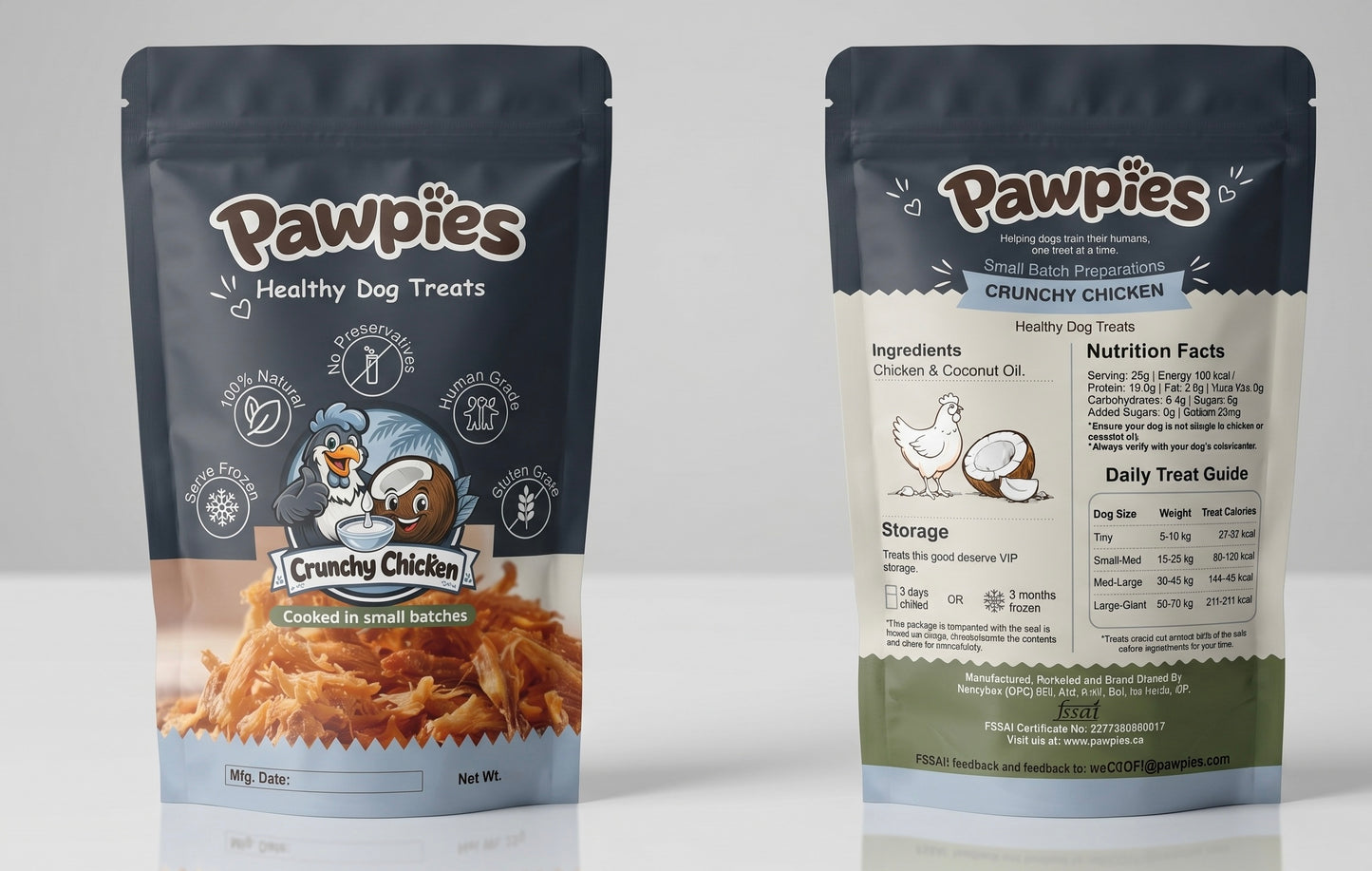
Bones vs Pawpies Crunchy Chicken
Why Feeding Bones to Dogs Can Do More Harm Than Good
Many dog parents in India still believe that giving bones is a natural and healthy way to satisfy their dog's chewing instincts. While chewing is indeed an important behavioural need, bones—whether cooked or raw—carry significant health risks that are often underestimated. From fractured teeth and intestinal injuries to bacterial contamination, the potential consequences can far outweigh any perceived benefits (FDA, 2010; Merck Veterinary Manual, 2025).
The good news is that dogs don't need bones to enjoy the sensation of crunching. They simply need a safe, satisfying alternative. The best alternative is Pawpies Crunchy Chicken

The Hidden Risks of Feeding Bones
1. Bone Splinters Can Cause Serious Internal Injuries
One of the greatest dangers of feeding bones is splintering.
Cooked bones become brittle during cooking and are especially prone to breaking into sharp fragments. These splinters can:
- Lacerate the mouth, tongue or gums
- Become lodged in the throat, causing choking
- Pierce the oesophagus
- Tear the stomach lining
- Perforate the intestines, leading to life-threatening infections
- Cause rectal injuries during passage
Many of these injuries require emergency surgery, and intestinal perforation can rapidly progress to septic peritonitis if not treated promptly (Merck Veterinary Manual, 2025; FDA, 2010).
Although raw bones are generally less brittle than cooked bones, they can still crack, splinter, or create intestinal obstruction depending on the type of bone, the dog's chewing style and the size swallowed (Merck Veterinary Manual, 2025).
2. Broken Teeth Are Surprisingly Common
Bones are much harder than canine teeth.
Veterinary dentists frequently treat slab fractures of the upper carnassial teeth caused by chewing hard objects such as bones, antlers and hooves. A fractured tooth exposes sensitive tissue inside the tooth, causing pain, infection and often requiring root canal therapy or extraction (AAHA, 2019).
3. Bones Can Cause Intestinal Blockages
Large bone fragments may become lodged within the digestive tract.
This may result in:
- Persistent vomiting
- Severe abdominal pain
- Constipation
- Loss of appetite
- Dehydration
Complete obstruction often requires surgical removal and can become fatal if treatment is delayed (Merck Veterinary Manual, 2025).

Chicken Feet: Natural Doesn't Always Mean Safe
Chicken feet are increasingly marketed as natural treats because they contain cartilage and connective tissue. However, they also present important food safety concerns.
Surface Bacteria
Raw poultry—including chicken feet—commonly carries bacteria such as Salmonella spp. and Campylobacter spp.(AVMA, 2024; Tufts University, 2021).
While healthy adult dogs may sometimes tolerate these organisms without obvious illness, puppies, elderly dogs, immunocompromised dogs and dogs with gastrointestinal disease are more susceptible to infection (AVMA, 2024).
Infected dogs may develop:
- Vomiting
- Diarrhoea
- Fever
- Lethargy
Even when dogs show no clinical signs, they can shed these bacteria in their faeces, increasing the risk of transmission to people, particularly young children, elderly family members and immunocompromised individuals (AVMA, 2024; Weese and Rousseau, 2005).
Contamination During Handling
Raw chicken feet also increase bacterial contamination within the home.
Preparation surfaces, food bowls, hands and kitchen utensils may all become contaminated if strict food hygiene is not followed (Weese and Rousseau, 2005).
Bones Are Not Essential for Dental Health
A common misconception is that dogs require bones to keep their teeth clean.
While chewing can help reduce some plaque accumulation, bones are not considered a safe or recommended method of dental care (AAHA, 2019; WSAVA, 2021).
Veterinary organisations continue to recommend:
- Daily tooth brushing
- Veterinary-approved dental chews
- Professional dental examinations
- Appropriate dental diets where indicated
These methods provide oral health benefits without exposing dogs to the risks associated with bones (AAHA, 2019).
Do Dogs Need Bones for the Crunch?
Not at all.
Dogs naturally enjoy crunching because it provides:
- Mental stimulation
- Stress relief
- A rewarding chewing experience
- Positive food enrichment (Case et al., 2011)
The crunch is what many dogs seek—not necessarily the bone itself.
Providing a safe, crunchy treat allows dogs to enjoy this natural behaviour while significantly reducing the risks of fractured teeth, choking and internal injury (Case et al., 2011).

A Safer Crunch: Pawpies Crunchy Chicken
For dog parents looking to satisfy their dog's love of crunchy treats without the hazards associated with bones, Pawpies Crunchy Chicken offers a simple alternative.
Each 25 g serving provides 18.8 g of high-quality protein, delivering approximately 75% protein by weight, while producing the satisfying crunch that many dogs enjoy. Unlike traditional bones, it is designed to provide the rewarding texture dogs love without exposing them to sharp bone splinters or the inherent risks associated with chewing bones.
As with any treat, it should be fed as part of a balanced diet and appropriate supervision is always recommended during feeding.

The Bottom Line
Bones have long been viewed as a traditional treat for dogs, but modern veterinary medicine has demonstrated that they carry genuine risks. Splintering, fractured teeth, gastrointestinal obstruction and bacterial contamination are all well-documented complications that veterinarians encounter regularly (FDA, 2010; Merck Veterinary Manual, 2025; AVMA, 2024).
Dogs certainly benefit from chewing and crunching, but they do not require bones to satisfy these instincts. Choosing safer alternatives allows owners to provide enrichment while reducing unnecessary health risks.
For many dogs, the safest crunch is one that delivers nutrition and enjoyment—without the potential trip to the emergency veterinary hospital.
References
American Animal Hospital Association (AAHA) (2019) AAHA Dental Care Guidelines for Dogs and Cats. Available at: https://www.aaha.org (Accessed: 21 July 2026).
American Veterinary Medical Association (AVMA) (2024) Raw Pet Food Diets and the Risks to Human and Animal Health. Schaumburg, IL: AVMA.
Case, L.P., Daristotle, L., Hayek, M.G. and Raasch, M.F. (2011) Canine and Feline Nutrition. 3rd edn. St. Louis: Mosby Elsevier.
Merck Veterinary Manual (2025) Gastrointestinal Foreign Bodies in Small Animals. Available at: https://www.merckvetmanual.com (Accessed: 21 July 2026).
Newbury, S. et al. (2017) 'Prophylactic and preventive health care for dogs and cats', Journal of the American Veterinary Medical Association, 250(6), pp. 612–624.
Tufts University Cummings Veterinary Medical Center (2021) Raw Diets for Pets: Risks and Benefits. Available at: https://vetnutrition.tufts.edu (Accessed: 21 July 2026).
U.S. Food and Drug Administration (FDA) (2010) FDA Warns About Bones Intended for Dogs. Available at: https://www.fda.gov.
Weese, J.S. and Rousseau, J. (2005) 'Survival of Salmonella Copenhagen in food bowls following contamination with experimentally inoculated raw meat: effects of time, cleaning and disinfection', Canadian Veterinary Journal, 46(10), pp. 887–889.
World Small Animal Veterinary Association (WSAVA) (2021) Global Nutrition Guidelines. Available at: https://wsava.org (Accessed: 21 July 2026).